Take me out to the ballgame.
What medical decision makers can learn from Major League Baseball.
Shared decision making is ideal in theory, but in reality, it is fraught with risks resulting from cognitive biases and undue influence of even the best-intentioned physicians and family members. Efforts should be made to minimize these concerns and to help patients to make decisions that their future selves are least likely to regret. [1]
Next week marks the end of the baseball regular season in the United States. Therefore I thought it would be timely to speculate what the world of medical decision making could learn from Major League Baseball.
In 2011, Daniel Kahneman published the highly acclaimed book: Thinking Fast and Slow. [2] It rapidly became a New York Times bestseller, was widely reviewed in the professional and general literature, and won several awards including the National Academy of Sciences Best Book Award. The book summarizes Kahneman’s research findings about factors that affect how people make decisions. The topics include discussions of heuristics and biases and the differences between two modes of thought: System 1, which is fast and automatic, and System 2 which is slow and deliberate.
On February 24, 2021, the New York Times published an interesting article describing how Kahneman’s book “…has become essential among many of baseball’s front offices and coaching staffs.” [3] In the article, John Mozeliak, president of baseball operations for the St. Louis Cardinals, is quoted as saying that an understanding of the information presented in the book was essential for “…working in a business that many decisions are based on what we see, what we remember, and what is intuitive to our thinking.” Sounds like medical decision making doesn’t it?
There is a small but growing body of literature addressing the implications of recent decision making research on medical decision making. A PubMed search on September 26, 2022 using the keywords “cognitive biases and medical decision-making” yielded 1,088 results, with a sharp uptick in activity starting about 2014:
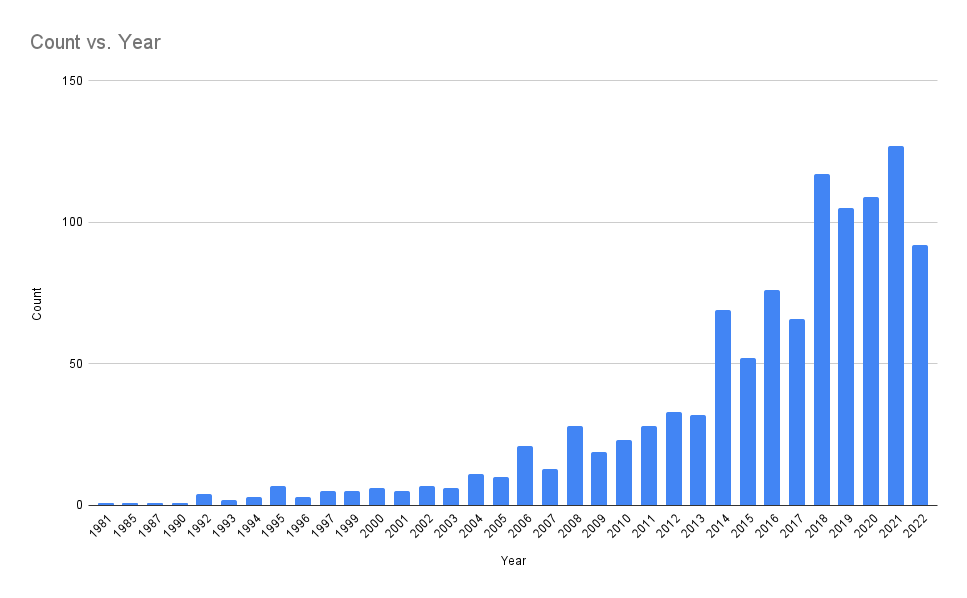
Most of these articles are about diagnostic decision making. A good review was recently published by J. Coughlan and colleagues. [4] (The original is behind the journal paywall, but a version is available on ResearchGate.) However, there is no reason to think that all areas of medical decision making could not be improved by judicious application of decision science research findings.
Musings
One of the goals of medical decision making is to make choices based on the best available evidence guided by patient preferences and values. Ensuring patients (and healthcare providers) compare options in ways that mitigate the harmful effects of known cognitive biases is an essential part of this process.
The available evidence suggests that many commonly used decision aids and other clinical information formats fall short in this regard. [1, 5-7] I therefore find it striking that none of the articles about Shared Decision Making, documented in recent Musings posts, discussed steps clinicians should take to mitigate potential adverse effects of cognitive biases on shared patient management decisions. To make true shared decision making a reality, more work needs to be done to learn how to create and implement well-crafted data presentation formats that foster unbiased, high quality clinical decisions.
References
1. Ozdemir S, Finkelstein EA. Cognitive Bias: The Downside of Shared Decision Making. JCO Clin Cancer Informatics. 2018;(2):1-10. doi:10.1200/cci.18.00011.
2. Daniel Kahneman. Thinking, Fast and Slow. Farrar, Straus and Giroux; 2011. Accessed March 12, 2021. https://us.macmillan.com/books/9780374533557
3. Lemire J. Why Baseball Is Obsessed With the Book “Thinking, Fast and Slow” - The New York Times. New York Times. https://www.nytimes.com/2021/02/24/sports/baseball/thinking-fast-and-slow-book.html. Published 2021. Accessed September 26, 2022.
4. Coughlan J, Mullins CF, Kiernan TJ. Diagnosing, fast and slow. Postgrad Med J. 2021;97(1144):103-109. doi:10.1136/postgradmedj-2019-137412
5.Ubel PA, Smith DM, Zikmund-Fisher BJ, Derry HA, McClure J, Stark A, et al. Testing whether decision aids introduce cognitive biases: Results of a randomized trial. Patient Education and Counseling. 2010 Aug;80(2):158–63.
6. Dolan JG, Cherkasky OA, Chin N, Veazie PJ. Decision aids: the effect of labeling options on patient choices and decision making. Medical Decision Making. 2015;35(8):979–86.
7. Fisher CF, Birkeland LE, Reiser CA, Zhao Q, Palmer CGS, Zikmund-Fisher BJ, et al. Alternative option labeling impacts decision-making in noninvasive prenatal screening. Journal of Genetic Counseling. 2020;29(6):910–8.


Comments
Post a Comment